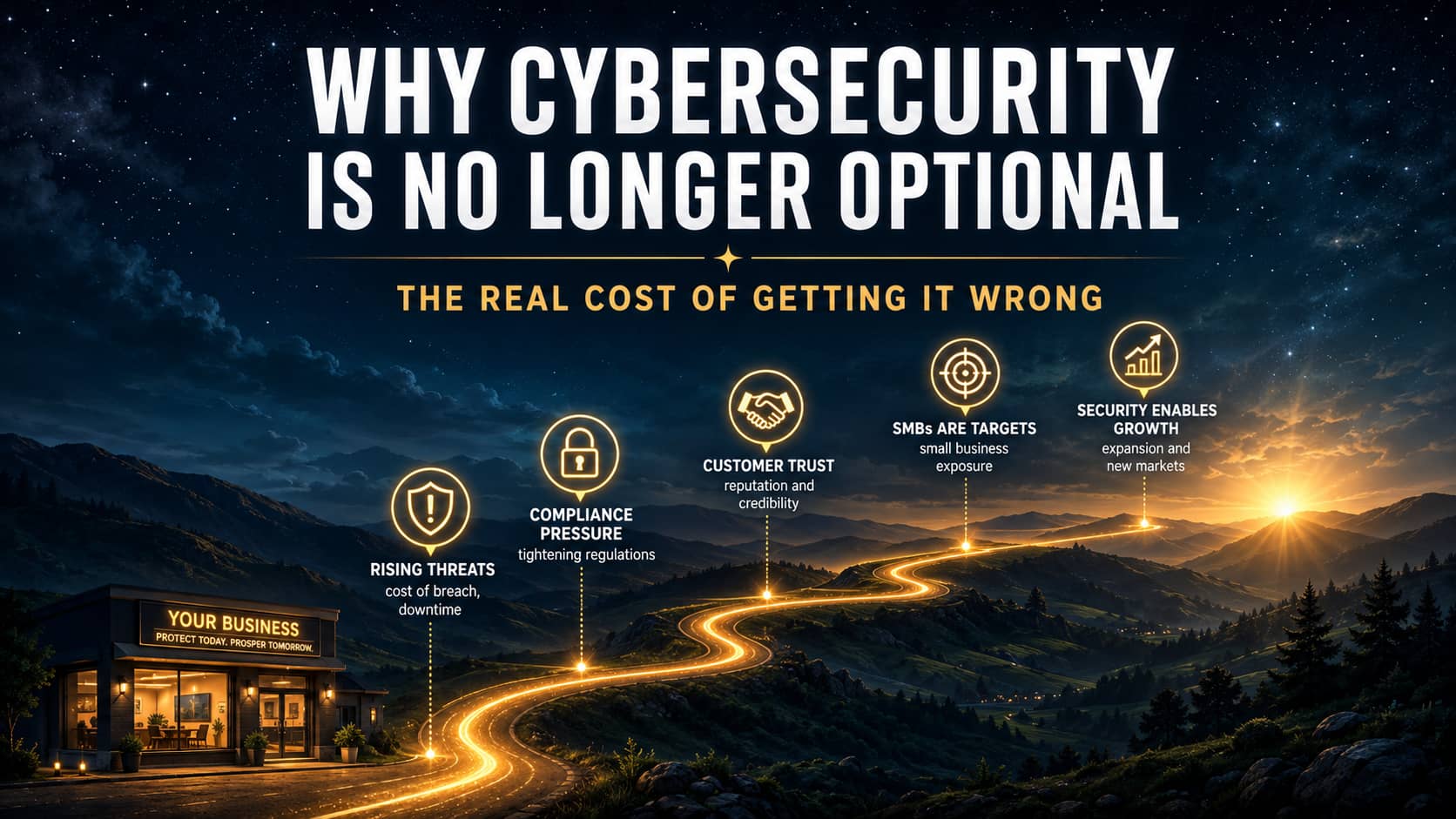
Cybersecurity used to be treated as an IT department's problem — something handled quietly in the background while the rest of the business focused on sales, operations, and growth. That mindset no longer holds. A single security incident can shut down operations, destroy customer trust, and trigger legal and financial consequences that outlast the breach itself by years.
For business owners and decision-makers, cybersecurity has shifted from a technical checkbox to a core business function. Here is why it deserves a permanent seat at the leadership table — backed by current industry data.
1. The Cost of a Breach Goes Far Beyond the Headline Number
The global average cost of a data breach was USD 4.44 million in 2025, according to IBM's Cost of a Data Breach Report — a rare 9% decline from 2024, driven largely by faster detection using AI-powered tools [1]. But that improvement masks a harsher regional reality: in the United States, average breach costs actually rose to a record USD 10.22 million, pushed up by regulatory fines and slower containment times [1].
Detection speed matters more than most businesses realize. In 2025, the average time to identify and contain a breach was 241 days — nearly eight months of undetected exposure before an incident is even fully understood [1]. The longer a breach goes undetected, the higher the eventual cost, particularly in regulated sectors like healthcare, where breach costs remain among the highest of any industry [1].
2. Small and Mid-Sized Businesses Are Now the Primary Target
There is a persistent myth that only large corporations get targeted. The data says otherwise. Verizon's 2025 Data Breach Investigations Report (DBIR), which analyzed over 22,000 real-world security incidents, found that ransomware was present in 88% of breaches at small and mid-sized businesses, compared to just 39% at large enterprises [2]. SMBs are not being spared — they are being singled out, precisely because they tend to have smaller security teams and thinner budgets to absorb an attack.
Industry-aggregated data drawing on the Verizon DBIR and the Hiscox Cyber Readiness Report 2025 (a survey of 5,750 SMEs across 8 countries) further indicates that roughly 43% of all cyberattacks target small businesses, and small businesses receive targeted malicious email at the highest rate of any organization size — an estimated 1 in every 323 emails [5].
3. People, Not Just Technology, Are the Weak Point
Firewalls and antivirus software matter, but they cannot compensate for human error. Verizon's 2025 DBIR found that 60% of breaches involved a human element — credential misuse, social engineering, or process mistakes [2]. Other industry research puts this figure even higher: some studies estimate that human factors contribute to as many as 88–95% of security incidents when broader definitions of "human error" are used [2].
The upside: this is also the most addressable risk. Organizations with structured security awareness training programs have been shown to reduce employee susceptibility to phishing by as much as 86% compared to their untrained baseline — meaning the single highest-leverage investment many businesses can make is training their own people, not just buying more tools.
4. Compliance Is Becoming a Competitive Requirement
Formal information security certification is growing sharply worldwide. According to the ISO Survey 2024, the number of valid ISO/IEC 27001 certificates — the leading international standard for information security management — reached 96,709 globally, nearly double the 48,671 recorded the year before, and up from just 36,362 in 2019 [3]. That is roughly a 2.7x increase in five years, reflecting how quickly formal security governance has moved from "nice to have" to a baseline expectation, especially for businesses that want to win contracts with larger, security-conscious clients [3].
5. Security Increasingly Determines Whether a Business Can Grow
Businesses with mature security practices are better positioned to expand into new markets, win enterprise clients who require security due diligence before signing, and adopt new technologies like cloud and AI without exposing themselves unnecessarily. IBM's 2025 report found that organizations using AI and automation extensively in their security operations saved close to USD 1.9 million on average compared to organizations with no such tools — a clear signal that smart security investment pays for itself [1].
Where to Start
Businesses do not need to build an enterprise-grade security operation overnight. A practical starting point usually includes:
1. A basic risk and vulnerability assessment to understand current exposure
2. Clear security policies covering data handling, access control, and incident response
3. Regular security awareness training for staff, since the human element remains the leading contributor to breaches
4. A roadmap toward recognized standards such as ISO/IEC 27001, particularly if compliance matters for your industry or client base
Cybersecurity is no longer a specialist concern reserved for banks and tech giants. The data is unambiguous: small businesses are now the most frequently targeted, human error remains the most common point of failure, and formal security governance is becoming table stakes for doing business at all. The organizations that treat security as a strategic priority today will be the ones still standing — and still trusted — when the next wave of attacks arrives.
References
[1] IBM Security, Cost of a Data Breach Report 2025, IBM Corp., Armonk, NY, USA, 2025. [Online]. Available: https://www.ibm.com/reports/data-breach
[2] Verizon, 2025 Data Breach Investigations Report (DBIR), Verizon Business, Basking Ridge, NJ, USA, Apr. 2025. [Online]. Available: https://www.verizon.com/about/news/2025-data-breach-investigations-report
[3] International Organization for Standardization, "The ISO Survey 2024 — ISO/IEC 27001 certificates," ISO, Geneva, Switzerland, 2025. [Online]. Available: https://www.iso.org/the-iso-survey.html
[4] Hiscox Ltd., Hiscox Cyber Readiness Report 2025, Hiscox Group, London, U.K., 2025.
[5] Bitwarden Inc., "Human error causes 60% of data breaches: How to protect your organization," Bitwarden Blog, 2026. [Online]. Available: https://bitwarden.com/blog/how-to-protect-your-organization-from-human-error-and-data-breaches/